
Finding My Groove in Electric Guitar Making at Nova Labs by Kalimar Maia


Four or so years ago when my father passed away, Christopher Sexton, woodshop steward and maker of fine dovetailed boxes (I think he’s made upwards of 60 of them), invited me to do some woodworking. He suggested it might be a good way to process things. Something inside me said "Great idea! I want to build an electric guitar!" Always with a gentle voice, he suggested maybe we start with a few other things first. Maybe learn a few things. Ok, Ok. So, with his help:
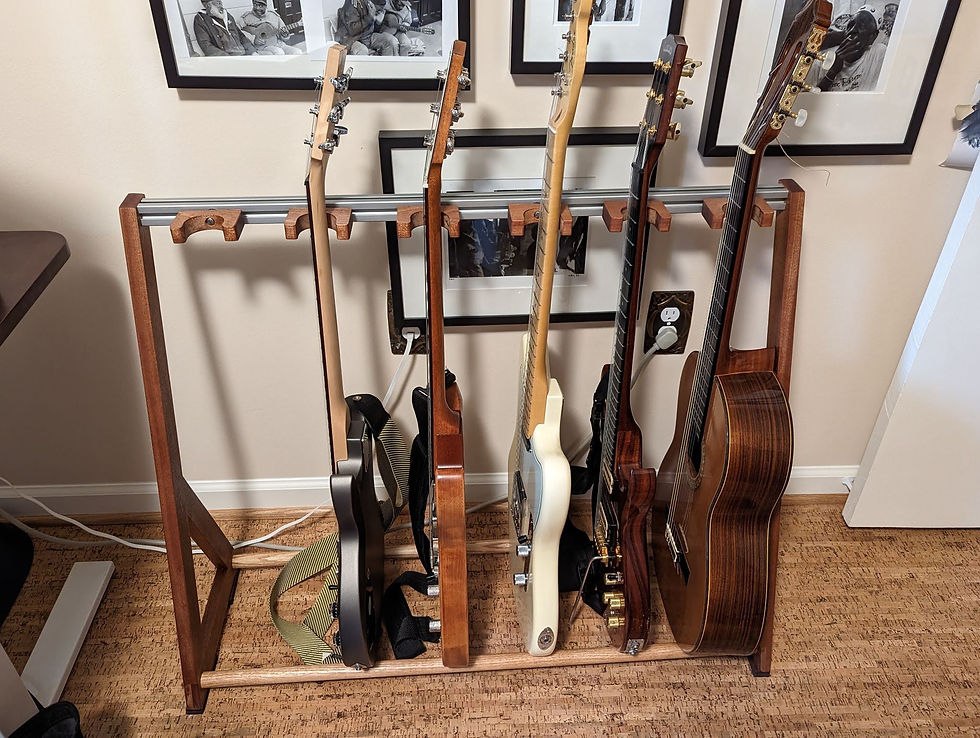
I made a guitar stand
Then a shower stool.

Made a couple of marking tools


And a pedal board.

With that, I naively decided I was ready! How hard could it be? I purchased an online course and a couple of nice pieces of wood from a hardwood company that specializes in luthiery and got started.
It turns out none of the previous projects really prepared me for what I was embarking on. I had gone through the motions, learned a couple of things but hadn’t really put in the real practice time needed. I hadn’t made enough mistakes. Hadn’t learned from fixing mistakes. To make matters worse, I only had one night a week to go into the shop and work on the guitar, and I really wanted to finish it. I would do things like cut out a template that was too thin for the router bit to register on and basically “lose” that night of work. At the time I didn't even know those words to explain this. So I would go home, buy some new wood for a template, and try it again the following week. I felt pretty discouraged, like no momentum was building. Like I would never finish.
While this was going on, my cousin and I were collaborating on our own electric guitar model — he was in Brazil, I was in the US, designing it remotely. It looked really cool on paper. Just no chance I would build it any time soon. Not at this rate. So I stopped going to the Labs. The pressure I put on myself to figure it all out was too great and I had to step back. I stopped for almost a year.
The following year that same cousin came to live with us for a few months. He's a master woodworker — metal worker, all-around handyman, and artist. He built a prototype of our custom guitar body on my back porch — the same design we'd been sketching out from continents. It was gorgeous.

He also made some templates and ordered some specific tools. It got me excited. I learned a lot from him. Mainly, to stop and think things through. Take a little more time to research, look at the possibilities. How might I approach this? I decided we needed to head back to Nova Labs. I quickly qualified for Key Member status, which requires a nomination and a few hours of volunteer work. I did a lot of dust collection work and tool organizing!
Back at Nova Labs and seeing some results I dove a little deeper into the craft and community. I spent a couple of days in Virginia Beach training with a luthier. We spent most of the time working through how to approach work. Every action in the shop is an opportunity to practice a skill. While the session didn’t have much to show, I learned a lot.
I joined an online community called "The Looth Group" and started hosting in-person gatherings at Nova Labs
I attended Fretboard Summit in Chicago. It’s a small guitar show with 80 or so instrument makers. I met several lovely people there who gave me lots of encouragement and advice.
Things started to click. I started to realize a couple of things:
It's not necessarily about knowing how to build a guitar — it's more about learning to think like a woodworker.
There can be no expectations or timeline. You have to blow that out and roll with it.
Mistakes will happen. You learn and you move on. Sometimes fixing those mistakes is the best lesson possible.
Everything you do in the shop is an opportunity to practice something. Even applying a clean line of double-sided tape requires practice. Or drawing proper lines on wood
With a renewed excitement and this paradigm shift, I started to develop some momentum. I succeeded in building a couple more guitar bodies. I helped Chris' son build a guitar body for himself.
I assembled a ukulele kit — much harder than one might realize. There’s so much to learn.
I built two cigar box guitars — another wonderful way to learn about guitars with much less on the line. The materials are cheaper and the process is much quicker.
2025 ended on a real high note. I delivered our custom guitar to Dani Toledo, a touring musician and producer out of New York.
Local Looth Group Meetup at Nova Labs Attending Fretboard Summit in Chicago Chris's Son's Guitar Ukulele Kit Assembly Cigar Box Guitar Dani Toledo Band with Kalimar's guitar Guitar pieces on display at Nova Labs Open House Guitars on display at Nova Labs Open House Attendee at Kalimar's Guitar Making Workshop at Nova Labs
I also participated in the Nova Labs open house. This event was really meaningful to me because it showed me my own arc — where I started and where I was going
2026 started with me teaching a 2-day intensive guitar kit building class. It was incredibly satisfying to see the faces of the participants with their final guitars.
I think as we age, having a hobby is critical. It can provide community and push the edges of what you're capable of, forcing you to grow in more ways than you realize or expect. Sometimes those moments can be thorny, but persist and the results are remarkable. Nova Labs is a wonderful place to find all of that.
I host the local Looth Group chapter at Nova Labs and teach occasional guitar-building workshops — if that interests you, come find me on a Thursday.
Follow Kalimar's maker journey on Instagram. https://www.instagram.com/mar_mar_guitars/


What a wonderful story you told about your time making electric guitars at Nova Labs! I love how you explained "finding your groove." It really gets to the heart of being creative with your hands. It would be interesting to know more about the problems you ran into while building block blast and how you solved them.
Traffic Jam 3D is an intriguing traffic simulation game in which players must carefully coordinate vehicle movements to clear chronic traffic jams. The game tests players' quick thinking and logical reasoning abilities on increasingly challenging levels.
Este contenido me pareció bastante práctico para quienes siguen regularmente los sorteos. Consultar el resultado loteria después de cada sorteo permite comprobar los números publicados de manera rápida. Tener la información bien organizada ayuda a los lectores a realizar esta consulta fácilmente.
A reliable water restoration company can be extremely helpful after a serious leak or flooding event. While researching Water Damage Restoration kansas city, I learned that professional technicians can assess affected areas and determine what needs to be removed, dried, or cleaned. Fast response combined with proper moisture detection can help reduce the impact of water damage on a property.
This touching anecdote shows that to succeed, we must accept mistakes, gradually learn modest skills, and enjoy the process. I think of the game monkey mart, where a small supermarket started with one banana and struggled through management mistakes before thriving once the rhythm was found and operations were maintained. Winning each small step is fantastic, whether playing a game or learning an instrument!